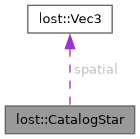
A star from the Bright Star Catalog. More...
#include <star-utils.hpp>
Public Member Functions | |
| CatalogStar ()=default | |
| CatalogStar (decimal raj2000, decimal dej2000, decimal magnitude, int name) | |
| Create a CatalogStar using its celestial/spherical coordinates. | |
| CatalogStar (Vec3 spatial, decimal magnitude, int name) | |
Public Attributes | |
| Vec3 | spatial |
| The point on the unit sphere where the star lies. | |
| decimal | magnitude |
| The apparent magnitude of the star (e.g., Sirius = -1.46, Polaris = 1.98). | |
| int | name |
| A unique number which unambiguously identifies the catalog star. | |
Detailed Description
A star from the Bright Star Catalog.
Definition at line 13 of file star-utils.hpp.
Constructor & Destructor Documentation
◆ CatalogStar() [1/3]
|
default |
◆ CatalogStar() [2/3]
|
inline |
Create a CatalogStar using its celestial/spherical coordinates.
- Parameters
-
raj2000,dej2000 The right ascension and declination of the star in the year 2000 magnitude See ::magnitude name See ::name
Definition at line 23 of file star-utils.hpp.

◆ CatalogStar() [3/3]
Definition at line 26 of file star-utils.hpp.
Member Data Documentation
◆ magnitude
| decimal lost::CatalogStar::magnitude |
The apparent magnitude of the star (e.g., Sirius = -1.46, Polaris = 1.98).
Definition at line 35 of file star-utils.hpp.
◆ name
| int lost::CatalogStar::name |
A unique number which unambiguously identifies the catalog star.
The catalog is an array, so in algorithms we usually refer to catalog stars by their index in the catalog. However, if the catalog is filtered (say, to remove stars that are too dim or too close to each other), the indexes change, which makes everything really hard to debug because indexes change based on how the catalog was filtered. That's what names are for: They're fixed and don't change.
Definition at line 40 of file star-utils.hpp.
◆ spatial
| Vec3 lost::CatalogStar::spatial |
The point on the unit sphere where the star lies.
The earth is at the center of the sphere. A star with right ascension and declination both equal to zero will lie at (1,0,0).
Definition at line 33 of file star-utils.hpp.
The documentation for this class was generated from the following file:
- src/star-utils.hpp
